
Cataracts are a natural part of aging, and for many patients in South Alabama, they begin to affect daily life long before symptoms become obvious. For nearly four decades, the Tillman Family Eye Care team has helped patients understand when cataract surgery is appropriate and what to expect. Today, cataract surgery is performed by our ophthalmologist, Dr. Aaron Brent McKinley, M.D., allowing patients to receive comprehensive surgical and medical eye care.
Cataract Surgery in Andalusia & Brewton

blurry vision?
What Are Cataracts?
A cataract forms when the natural lens of the eye becomes cloudy. Most people develop cataracts gradually, which is why early symptoms often go unnoticed. As the lens becomes more opaque, you may begin to notice blurry or hazy vision, difficulty driving at night, fading or yellowing colors, and light sensitivity or glare.
Cataracts can’t be reversed with glasses; surgery is the only way to restore clear vision. The good news is that cataract surgery is one of the most successful medical procedures performed today, and our team guides you through every step.
Quick Links
When Is It Time for Cataract Surgery?
There is no single “age” or prescription level that determines when a cataract must be removed. Instead, surgery is recommended when your cataracts begin to impact your daily activities, such as reading, driving, recognizing faces, or functioning comfortably in low-light environments.
During your eye exam, we evaluate:
-
How much the cataract is affecting your clarity
-
Glare and night-driving vision
-
Overall eye health
-
Whether surgery would realistically improve your quality of life
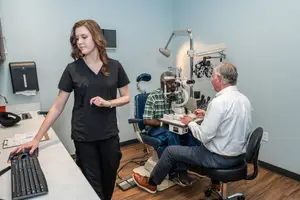
Cataract Surgery at Tillman Family Eye Care
Cataract surgery is performed by Dr. Aaron Brent McKinley, our cataract and glaucoma surgeon. You receive your preoperative evaluation and postoperative care from our team, ensuring personal support and continuity at every step.
Before Surgery
We conduct an evaluation and measure your eyes to determine the best lens option. We review your medical history, answer questions, and walk you through what to expect on the day of surgery. Dr. McKinley will discuss your lens options based on your needs.
During Surgery
Your surgery is performed by our ophthalmologist, Dr. Aaron McKinley. The eye is gently numbed, and you may notice only light pressure or movement as the cloudy lens is removed and replaced with a clear artificial lens.
After Surgery
Your follow-up care is completed in our office. We monitor your healing, ensure the eye is responding as expected, and help you transition back into comfortable vision. Most patients appreciate returning to the same team that has been guiding their care for years.
In-Office YAG Capsulotomy
For some patients, vision can become cloudy months or years after cataract surgery due to a common condition called posterior capsular opacification. It feels very similar to a cataract returning, but the solution is simple.
Dr. McKinley offers in-office YAG laser treatment, which uses a painless laser to clear the clouded membrane behind the artificial lens. The procedure takes only a few minutes and typically restores clarity almost immediately.
Questions About Cataract Surgery
Some patients still need glasses for reading or certain tasks, while others enjoy clearer vision at multiple distances depending on the lens chosen. We’ll discuss the options that fit your needs and lifestyle.
The surgery itself typically takes about 10–15 minutes per eye. Most of the time is spent preparing before and recovering afterward.
That’s exactly why co-management is so important. We evaluate your eye health, including glaucoma, macular degeneration, or diabetic changes, to ensure surgery is appropriate and safe.
Most surgeons perform the second eye about one to two weeks later. We help coordinate these dates and manage care between surgeries.
Ready to Restore Clarity?
Cataract surgery is a major step toward clearer vision, and you shouldn’t have to navigate it alone. If you’ve noticed cloudy or hazy vision, difficulty with night driving, or other signs of cataracts, we’re here to guide you through evaluation, surgery, and follow-up care. Schedule your cataract evaluation and let our family guide you through every part of the process.